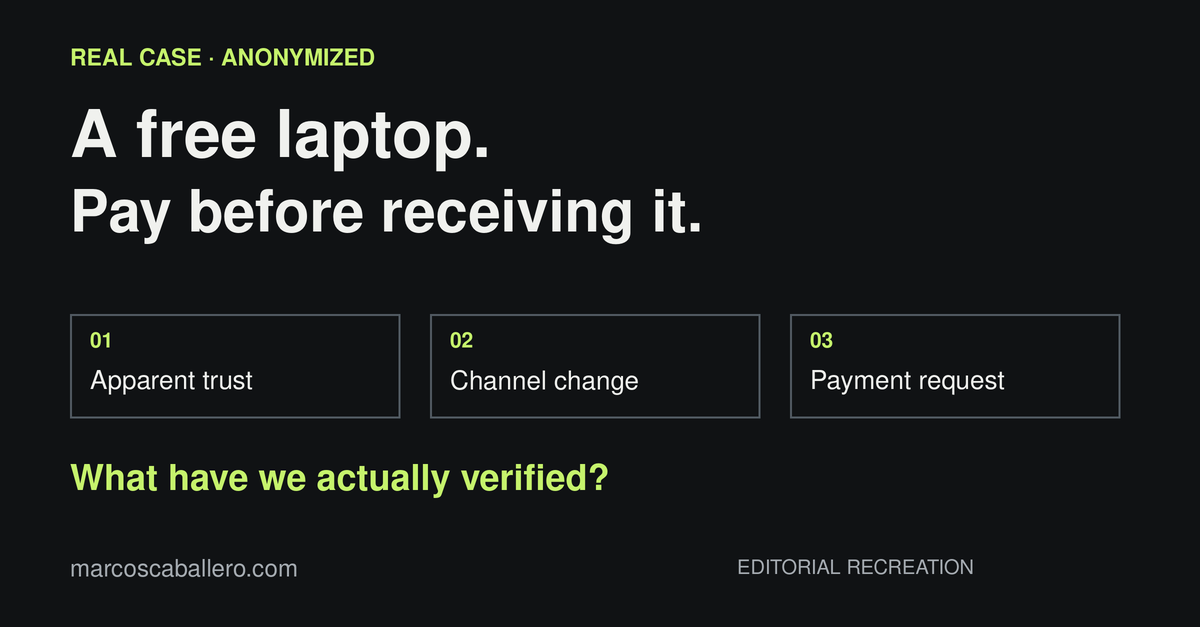
The email did not begin by asking for a password. It offered musical instruments, a games console, a phone and a high-end laptop. Everything was free. The recipient only had to pay for delivery.
I have been able to examine this case closely, and it is worth sharing. The aim is not to blame someone who was excited by an offer, but to understand how an apparently simple conversation can lead to a request for money.
I have anonymized the family, student, school and correspondents. No real bank transfer took place. This account is reconstructed from message content and available screenshots; it is not a forensic investigation of the email system.
First, an offer arrives in a familiar context
A student received a message displaying an address from an educational institution as its sender. The subject announced a donation. The text claimed that someone needed to give away personal possessions after the death of their partner.
The list combined musical instruments with attractive technology products. It used emojis, familiar brands and a condition: the items were free, but the recipient had to pay for shipping. Collection was unavailable. The reader was also urged to act quickly and continue from a personal email account.
For a student interested in a laptop, the message offered something specific they wanted. The apparent school origin provided context. That does not establish that the school endorsed the offer, but helps explain why someone might initially consider it credible.
The first significant change: leaving the school channel
The message explicitly instructed recipients not to reply from their school account. The student wrote from a personal address and copied an adult. The subsequent reply did not include that adult and referred the student to a supposed shipping company.
These are observable facts. I cannot establish why the copied recipient was removed: it could have been a reply to the sender only. In isolation, that change does not prove intent. In the wider sequence, it deserves attention.
The key issue is that the conversation was moving away from the context that had lent it credibility, toward new channels and correspondents. The appropriate next step was to pause and confirm the donation with the school using a known contact obtained independently of the message.
Kindly contact with your personal email, do not reply with your school emailThe recipient is asked to leave the school channel. Before continuing, confirm the offer with the school through an independent contact.
A new shipping contact inherits the previous trust
The supposed donor supplied a moving contact, a reference and a Gmail address. They also included a link to the genuine website of a well-known logistics company. The next correspondent used that brand in their display identity.
Linking to an authentic website does not establish that someone works for the company. Anyone can copy a public address. What needs verification is the relationship between the writer, the organization they claim to represent and the specific transaction.
Gmail alone does not prove fraud either. Here, the mismatch between the logistics brand invoked, the email account used, differing trading names and the later individual beneficiary required independent verification. Trust should not transfer automatically simply because the previous correspondent introduced the next one.
How trust moves through the exchange
- Apparent school emailAn attractive offer in a familiar context.
- Personal accountThe recipient is asked to leave the school channel.
- Supposed carrierA new correspondent invokes a known brand.
- Urgency and paymentThe gift requires shipping and insurance fees.
- Break the chainVerify through independent channels before paying.
The sequence is observable; it does not establish compromise of the school account or identify the operators.
A gift becomes a payment obligation
The conversation moved to delivery prices. Two delivery times were offered and mandatory insurance was added. A payment of €217 was then requested before the supposed parcel could ship.
What matters is the combination: a supposedly free, valuable item, no collection option, an unverified shipping provider and an advance payment needed to receive the gift. The exchange was already focused on payment without establishing the donation’s legitimacy or the item’s existence. We should not let an apparently small fee replace verification of the transaction itself.
Urgency tries to replace verification
The supposed carrier repeatedly asked whether to proceed or cancel and give the item to someone else. The initial offer had already introduced scarcity and speed: act before the opportunity disappears.
This framing shifts attention. Instead of asking whether the transaction is real, we start asking whether we will be in time. Each reply and delivery choice can also make us more invested in completing the process.
For me, this is a good point for a deliberate pause. If we cannot verify who is donating, who is transporting and who receives payment, urgency answers none of those questions. A legitimate transaction may also have deadlines, but a deadline does not turn an unverified identity into a trustworthy one.
Please confirm if we should proceed with this order or we should cancel the order and give it to someone else?The prospect of losing the gift pressures the recipient to decide. Urgency does not validate the carrier or beneficiary.
The payment beneficiary needs an explanation too
Several payment methods were offered, including bank transfer and cryptocurrency. When a transfer was requested, European bank details were supplied with an individual named as beneficiary.
A plausible IBAN, a real financial institution or an identifiable beneficiary does not establish the offer’s legitimacy. Nor does it establish that the named person committed the fraud: without investigation, we do not know who controls the account or whether another person’s identity is being used. That is why I am not publishing those details.
Before paying, I would require a verifiable explanation connecting the beneficiary, carrier and transaction. Verification should be with the company through its official channels, not another contact supplied by the person requesting payment.
What happened with the supposed payment receipt
To continue the exchange, an adult created an entirely fictitious document and sent it as a supposed payment confirmation. No money was transferred and no real bank transfer took place. The available response said payment would be confirmed and the shipment processed, and that a tracking reference or invoice would follow.
That response does not establish that funds arrived, a shipment existed or anyone checked the document. The sender has now been blocked in the email systems to prevent further conversations.
I do not recommend continuing clearly suspicious conversations unless you are a cybersecurity professional with a legitimate purpose, a procedure and a controlled environment for doing so. Being a professional does not, on its own, remove the risk of prolonging contact or exposing more information. For other readers, the recommendation is to stop the conversation, preserve evidence and report.
The document is not reproduced or offered as a template. Its role here is to clarify that a simulation was used to continue the conversation, not that a payment was made.
What we know and what remains unknown
We know the offer’s content, the move to personal accounts, the referral to a supposed carrier and the request for money. Together, these fit an attempted advance-fee scam. Proofpoint documented piano donation campaigns in 2024 with a similar sequence: a free offer, a family story and advance shipping charges. Similarity does not establish that the same people were involved here.
We have not examined the original EML message, complete headers or school logs. I therefore do not claim that a school account was compromised or the sender was spoofed. Nor do I claim that the names used identify the account operators. Those hypotheses require additional evidence. The content supports an assessment of the attempted transaction, not technical attribution of its origin.
Emojis and a padlock do not decide for us
Emojis help present and organize the offer, but are not a reliable indicator on their own. Neither are writing errors. A well-written message can be fraudulent, and a legitimate one can contain mistakes. Graphics hosted by familiar services do not validate the sender.
One screenshot displays a TLS indicator. That concerns protection of message transport, not the truth of the donation. Likewise, SPF, DKIM and DMARC are important email authentication controls, but do not certify commercial intent or message content.
Their results are unknown in this case. Even a compromised legitimate account may send authenticated mail. Technical assessment and verification of the transaction need to complement each other. A familiar interface or security label should not stand in for checking the requested action.
What I would do with a similar message
I would not pay or send more information while the transaction remained unverified. I would contact the school through a phone number or address already known to me, and the supposedly involved company through its independently located website. I would confirm that the donation exists and that the carrier is connected to it.
I would retain original messages, preferably EML files with headers, and correspondence evidence. I would notify the school’s email administrators and report accounts through their providers’ channels. These are recommended actions, not claims that they have already been completed here.
If money was actually paid, contact the bank promptly to try to stop or recover the payment and preserve documentation for reporting to the authorities. Recovery is not guaranteed. If credentials were shared, change them and review sessions and access with the provider.
The lesson is not to distrust someone asking for help
This case does not show that students are careless. It shows an offer matching a specific desire, presented in a familiar context and followed by small steps ending in a request for money.
At home and in education, I want asking for help and reporting concerns to feel easy, without fear of a reprimand. Replying to an email does not automatically mean an account is compromised; we should still establish which information was shared and what happened afterwards.
The question I take away is simple: what have we actually verified, and what are we accepting because it appeared in the previous message? An apparent school origin, a genuine brand website and a delivery reference can form a convincing story. Every claimed relationship still needs independent verification.
Further reading
Official sources for checking and exploring these concepts. This article presents a practical approach; it does not reproduce the references’ full requirements.
An anonymized real case. Visuals are editorial recreations, not original screenshots or banking documents. Conclusions distinguish observed facts from unverified hypotheses.